Anti-Icing Versus De-Icing: Why Treating Before the Storm Costs Less
Once ice bonds to pavement, everything downstream gets harder; anti-icing exists to stop that bond from forming at all.
September 22, 2026 · 4 min read
De-icing and anti-icing get used as if they mean the same thing, and on a purchase order they might even look like the same line item. They are not the same job. One happens before the storm and one happens after, and the difference in timing changes how much product it takes to get a clean, safe surface once the weather has passed.
Two different jobs
De-icing means applying product after ice or snow has already formed, to melt it or break the bond it has formed with the pavement underneath. Anti-icing means applying a liquid treatment to the pavement ahead of a forecasted storm, before any precipitation has fallen, so that ice never gets the chance to bond to the surface in the first place. Both are legitimate parts of a winter maintenance plan, but they solve different problems and one is significantly easier to execute than the other.
Why the bond is the real problem
Once ice has physically bonded to pavement, a plow blade cannot fully remove it. Mechanical clearing only takes off the loose top layer, leaving a bonded base layer that still has to be melted through with product, and melting through an existing ice layer takes more material than preventing the bond would have taken. The bond itself, not the ice sitting on top of it, is what makes a storm expensive and slow to clean up after the fact, and it is also what leaves a slick, hazardous surface underneath even after a plow has made several passes.
How anti-icing works
A liquid brine, either magnesium chloride or calcium chloride, applied to pavement ahead of a storm forms a thin barrier layer. When precipitation arrives, it lands on that barrier instead of bonding directly to the pavement surface, which keeps the resulting ice loose enough to clear mechanically. Because the treatment is doing prevention rather than trying to melt through an already-bonded layer, it generally takes a smaller amount of product to get the same result as a reactive de-icing pass after the fact. A liquid also spreads more evenly across a surface than a dry granular product, which is part of why pretreatment is typically done with brine rather than pellets.
Where calcium chloride earns its place
Calcium chloride works at lower temperatures than rock salt, which makes it the product of choice once conditions get cold enough that other de-icers stop working effectively. CalTrak calcium chloride, available as 1 to 3mm mini-pellet prills or 4mm pellets, is built for that fast-acting reactive role when ice is already down, while calcium chloride brine can also serve as a pretreatment ahead of the coldest events where a magnesium chloride brine might not perform as well.
The logistics side
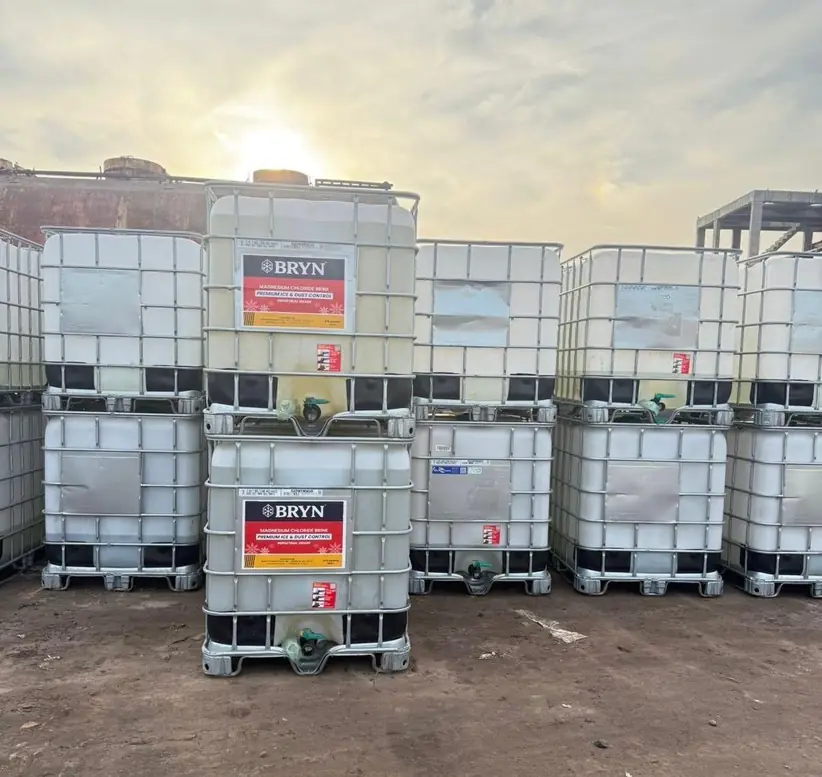
Brine for anti-icing pretreatment moves in 275 gallon IBC totes for smaller operations or 4,000 gallon Flexitanks for larger ones, shipped direct by rail, container, or truck. Pelletized calcium chloride for reactive de-icing stocks well in 50 lb bags or one-metric-ton Super Sacks, sitting in reserve until conditions call for it. A winter maintenance program that runs both, brine ahead of the forecast and pellets in reserve, is set up to handle a storm at both ends rather than reacting to it after the fact, and it means a facility is not caught deciding what to order in the middle of an active weather event.
When anti-icing is not the right call
Anti-icing depends on a forecast that gives enough lead time to treat a surface before precipitation starts, and on a surface dry enough for the brine to bond properly rather than washing off in rain that arrives ahead of the freeze. A storm that turns cold with little warning, or one that opens with rain before switching to snow, can leave a pretreatment washed away before it does its job. That is exactly why pelletized product stays in reserve rather than being treated as a backup that is rarely needed: reactive de-icing is still the right tool whenever conditions do not cooperate with a pretreatment window.
Putting a plan together
Watch the forecast, pretreat exposed pavement with brine ahead of a predicted event, and keep pelletized product on hand for anything the pretreatment does not fully prevent. Confirm application details against the Certificate of Analysis for the lot you are working with, since concentration and purity affect how a given batch performs in the field, and build reordering into your schedule well before stock actually runs low. A facility that treats anti-icing and de-icing as two stages of one plan, rather than picking one approach and using it for everything, tends to spend less product overall and clears faster once a storm has passed.
Bryn-It, (425) 923-7909
Call (425) 923-7909More articles
Magnesium Chloride or Calcium Chloride: Choosing the Right Deicer for Your Site
Both products melt ice and knock down dust, but they get there by different routes, and the route matters once the temperature drops.
Dust Control on Haul Roads and Arenas: What Actually Stops the Dust
Water evaporates in hours. A hygroscopic treatment keeps pulling moisture back into the surface long after the truck has moved on.