Magnesium Chloride or Calcium Chloride: Choosing the Right Deicer for Your Site
Both products melt ice and knock down dust, but they get there by different routes, and the route matters once the temperature drops.
September 22, 2026 · 4 min read
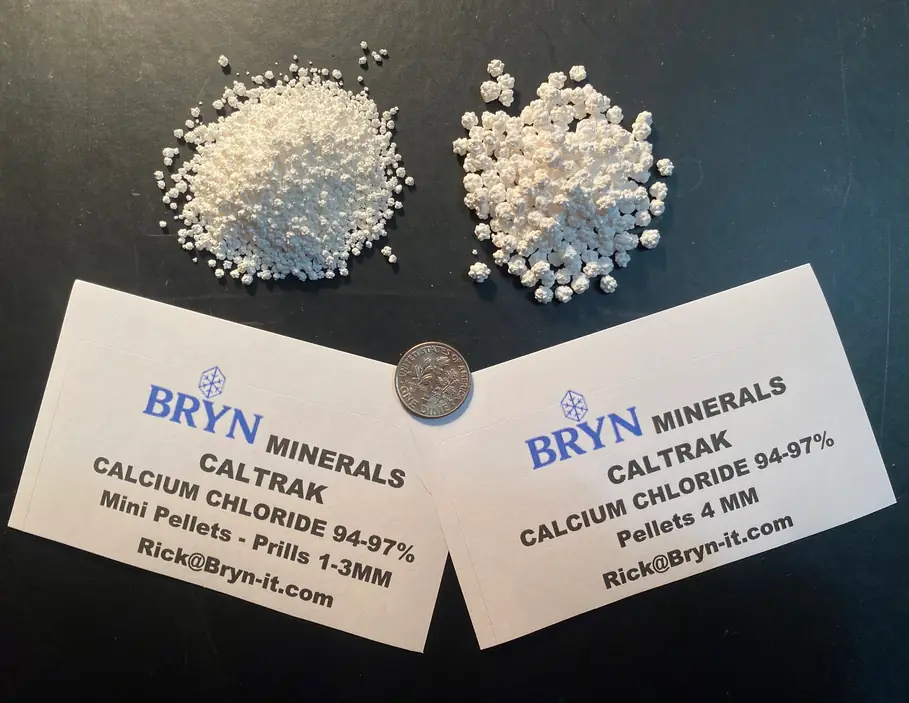
Anyone who buys bulk chloride for a living eventually asks the same question: magnesium or calcium. The two products sit next to each other on most supplier price sheets, get quoted for overlapping jobs, and are treated as interchangeable by buyers who have not had to compare them directly. They are not interchangeable. Purity, form, and how each one behaves in the cold are different enough to change which one belongs on your site.
What each product actually is
Magnesium chloride ships as a 47% flake or as a 40% liquid brine. The flake is a solid you spread; the brine is a ready-to-use liquid you spray. Calcium chloride ships at 94 to 97% purity, either as a 1 to 3mm mini-pellet prill or a 4mm pellet, or as a 37% liquid brine. The purity figure on calcium chloride is a solid-content number for the dry pellet form, not a like-for-like comparison with the magnesium chloride flake percentage, which is why lining the two up on a spec sheet without reading the units first is a common mistake.
Both products also come as liquid brine, and both liquids get treated by buyers as more or less the same thing because they arrive in the same 275 gallon IBC tote shape. They are not the same brine. A magnesium chloride brine and a calcium chloride brine will not necessarily perform identically at the same concentration, so a switch from one to the other on the same equipment is worth a fresh look rather than an assumption that the settings carry over.
Purity, form, and how fast it goes to work
Form factor decides how a product behaves before it decides anything about chemistry. A prill or pellet has more surface area relative to its size than a flake, so it tends to start working sooner once it contacts moisture on the pavement. A flake dissolves more gradually, which is part of why it is favored where the job is drawing moisture out of a surface over time rather than melting ice fast. Neither form is universally better; they are suited to different timelines, and a site that only stocks one product because it worked once on a different job can end up fighting the clock unnecessarily.
Temperature performance
Calcium chloride works at lower temperatures than rock salt, which is the reason it gets specified for the coldest jobs and the reason it is the fast-acting choice when ice has already formed. The mechanism behind both chloride products is the same at a basic level: dissolving is exothermic, so the reaction itself releases a small amount of heat, and both are hygroscopic, meaning they pull moisture out of the surrounding air and keep the surface wet rather than letting it refreeze. Exactly how far below freezing a given product keeps working depends on concentration and application rate, and that is a specification question, not a marketing one. Confirm it against the Certificate of Analysis for the lot you actually have rather than a general number you read somewhere else.
Corrosion and handling
Magnesium chloride is less corrosive and carries lower residual toxicity than traditional salt-based deicers, which matters on sites with a lot of exposed metal, concrete flatwork, or nearby vegetation. That difference is often the deciding factor for facilities that have to worry about long-term wear on equipment, bridge decks, or landscaping alongside a treated surface, separate from whichever product melts ice faster on paper. Both products are fully water soluble and non-hazardous under OSHA standards, and a full Safety Data Sheet ships with every order. Read it before you decide how the product gets stored and handled on your site, not after.
Beyond ice: dust and specialty applications
- Magnesium chloride flake and brine: dust suppression on haul roads, mine sites, construction sites, and equestrian arena footing
- Magnesium chloride: anti-icing and de-icing, including stopping ice from bonding to pavement in extreme cold
- Calcium chloride: fast-acting de-icing and dust control
- Calcium chloride: tractor tire ballast
- Calcium chloride: oil and gas well work, including completion fluid, stabilizing shale formations, sealing well casings, and displacing drilling mud
Making the call
If the job is long-duration dust control on a haul road or an arena surface, magnesium chloride flake or brine is the product built for that. If the job is fast ice control in genuinely cold conditions, calcium chloride pellets or prills are the faster-acting choice. If the work touches an oilfield application such as completion fluid or shale stabilization, calcium chloride is the product with a documented history in that space. When a site runs both winter maintenance and summer dust control, it is common to stock both products rather than force one to do the other's job.
Whichever product you land on, order it in the packaging format your site is already set up to handle, whether that is 50 lb bags, one-metric-ton Super Sacks, IBC totes, or Flexitanks, and request the Certificate of Analysis for the specific lot before it ships. Keep it with your site records, and if anything about a spec looks off from what a previous order showed, that is a conversation to have with the supplier directly before the material goes into use.
Bryn-It, (425) 923-7909
Call (425) 923-7909More articles
Dust Control on Haul Roads and Arenas: What Actually Stops the Dust
Water evaporates in hours. A hygroscopic treatment keeps pulling moisture back into the surface long after the truck has moved on.
Bags, Super Sacks, Totes, or Flexitanks: Choosing the Right Packaging Format
The right packaging format has less to do with total volume and more to do with what your forklift, hopper, or spreader can actually handle.